
Pekin Directory Collections by Year
Pekin has an unusually deep directory trail. The Pekin Public Library Local History Room holds city directories beginning in the nineteenth century, White's county volumes, school annuals, maps, atlases, and newspaper tools. The TCGHS Digital Archive supplies searchable scans for two major title groups. Its inspected title inventory reports 4,300 pages for Pekin City Directory and 1,521 pages for Tazewell County Directory. Those counts describe the archive titles, not an unbroken annual run.
| Collection | Years | Where Held | Access |
|---|---|---|---|
| Root, Sellers, and Bates city volumes | 1861; 1870-71; 1875-76; 1887-88; later Bates years through 1922 | Pekin Public Library and TCGHS | Shelf volumes and selected free scans |
| Polk and later Pekin directories | Polk from 1924; later holdings include 1926-39 and 1966 forward | Pekin Public Library and ISGS holdings | Confirm the exact volume before visiting |
| Pekin City Directory digital title | 1861-1921 | TCGHS Digital Archive | Free title/year browse, OCR, and page viewer |
| J. A. White county directories | 1914-30 selected even years | Library and TCGHS collections | County and rural-route context |
No safe search assumes that a Pekin city directory appeared every year. The known run has publisher changes and gaps, including isolated early editions, dense coverage in parts of the 1890s through 1920s, and later telephone-directory runs. Record the title, publisher, year, page, and repository for each find. If the desired year is absent online, call the library or the Tazewell County Genealogical & Historical Society before concluding that no volume exists.
The library's local history collection page is the official lead for checking directory, newspaper, and genealogy holdings.

The collection page confirms that directory work can be paired with microfilm, yearbooks, maps, and staff research when an online scan is missing.
Pekin City Directory Publishers
The publication sequence helps date an entry and explains why layouts change. Root's 1861 volume predates a full numbered-address system. Sellers & Bates issued the 1870-71 directory, Bates followed in 1875-76 and 1887-88, and later local runs continue through 1922. The library identifies 1924 as the first local Polk volume after the Bates era. Later volumes support closer year-to-year address work, but availability still must be checked by exact title and year.
| 1861 | Root's 93-page city book, with alphabetical household heads on pages 12-64 plus civic, street, transit, school, association, religious, and business sections. |
|---|---|
| 1887-88 | Bates volume in the first numbered-address period noted by the library. |
| 1903-04 | First cross-referenced street index found in the local chronology. |
| 1924 | Polk replaces the prior Bates sequence in the documented transition. |
The broader county shelf matters too. White's directories list towns, Pekin, businesses, and rural delivery routes. In those volumes a cross can mark a household head, while a large dot can identify a farm landowner. Read the symbol key in the same edition rather than carrying a convention from one publisher into another.
The library's Pekin directory chronology documents the publisher and address-format changes.
The chronology helps a reader choose the right edition before searching a surname or modern street number.
Search Pekin Directories Online
The TCGHS archive lets a researcher browse by title and year, enter a person, place, or event, and open a scan from an OCR result. OCR means optical character recognition, software that turns a page image into searchable text. A test for Smith within the Pekin title produced 869 hits, each with title, date, text snippet, location path, page, and viewer link. That is a useful index, not final evidence.
- Select the Pekin City Directory title before entering a name. This avoids mixing newspaper, deed, and county-directory hits.
- Try surname variants and a known street. Browse nearby years if the expected edition is missing.
- Open the viewer and inspect the full scanned page. Save its publication year and page number with the transcription.
- Check the abbreviation key and neighboring entries. OCR often misreads short marks, initials, and street numbers.
The TCGHS directory viewer shows how a digitized volume opens as page images. The scan, not the result snippet, is where a name and address should be checked.
When Pekin Addresses Changed
Pekin's address history is a key search clue. Root's 1861 listings may describe a person at a corner, such as the northeast corner of two named streets. Numbered addresses appear in the library's chronology by 1887. The 1903-04 edition then adds a cross-referenced street index, making it possible to move from an address to occupants as well as from a surname to an address.
The library's 201 Catherine case study follows one site from corner descriptions into a numbered address and then across a long series of households. Entries through 1939 show that the same recognizable place can remain while names, family notes, and work descriptions change. This is a strong family-history and address-history method because it keeps dates attached to each claim. For current address-keyed records, use the Pekin street directory lookup rather than treating an old listing as present-day occupancy.
Note: A change from a corner description to a number may reflect a naming system, not a move by the person listed.
Read a Pekin Directory Entry
A printed entry can compress a household into one line. Read it as a dated publisher record. The surname and given name identify the listed person, an occupation or workplace may follow, and a residence mark can lead to a street or rural route. Parentheses may carry a spouse or child count. Terms such as widow, boarder, foreman, or works are often shortened. The exact abbreviation key controls the meaning.
| Name | Usually the listed householder; later entries may include a spouse in parentheses. |
|---|---|
| Work | An occupation, employer, or short work descriptor may appear. |
| Address | A corner in early books, then a house number and street; rural entries may use R.F.D. |
| Household mark | Publisher symbols or shorthand may distinguish a householder, boarder, or landowner. |
| Family clue | “wid” and a spouse's given name can connect the line to obituary or vital research. |
- Criss-cross directory
- A later address-ordered section that groups entries by street and house number.
- Householder index
- A list centered on the person treated as the household's main entry, not every person at the address.
- Abbreviation key
- The publisher's legend for marks such as r, h, bds, wid, fore, and wks. Save it with the page.
A 1903 scan, for example, includes an Anna Smith described as the Pekin Public Library librarian with a South Capitol address. That historical line is useful because the name, work, address, year, and page can be checked together. It does not establish a present fact about any resident.
Pekin Directory Research Rooms
The library at 301 South Fourth Street is the main local-history stop. Its posted hours are Monday through Thursday, 9:00 a.m. to 8:00 p.m.; Friday, 9:00 a.m. to 6:00 p.m.; and Saturday, 9:00 a.m. to 5:00 p.m. Call 309-347-7111 before a focused visit. The room combines directories with Pekin Daily Times microfilm from 1914 through December 2018, yearbooks, school papers, maps, atlases, images, and in-library genealogy databases.
The Ehrlicher Research Center, 719 N. 11th Street, adds nearly 15,000 volumes, computers, microfilm tools, land and naturalization records, cemetery material, and volunteer help. Posted hours differ across society pages, so call 309-477-3044 or arrange an appointment for fragile originals. Online, in-person, phone, email, and mail research are all documented paths. Illinois State Archives and IRAD finding aids provide a further copy route when neither local shelf holds the needed year.
Pekin Obituaries Confirm Directory Clues
A disappearance from a city directory does not say why the person vanished from the next volume. The household may have moved, the publisher may have skipped a year, the name may sit under another householder, or the person may have died. The library's Pekin Daily Times obituary index supplies a date, page, and column from 1914 to the present, giving the precise coordinate needed to inspect microfilm or later newspaper access.
Library quick searches up to 15 minutes are listed as free. One hour is $15 and two hours are $30. Exact-name and exact-date obituary orders cost $5 for one to five copies and $10 for six to ten. Requests can be sent to obituary@pekinpubliclibrary.org. TCGHS also offers obituary work, scanned uncertified death certificates from 1877-1950, and scanned marriage licenses from 1869-1950. Those scans are research aids. Certified records must come from the proper county or state custodian.
Map a Pekin Directory Address
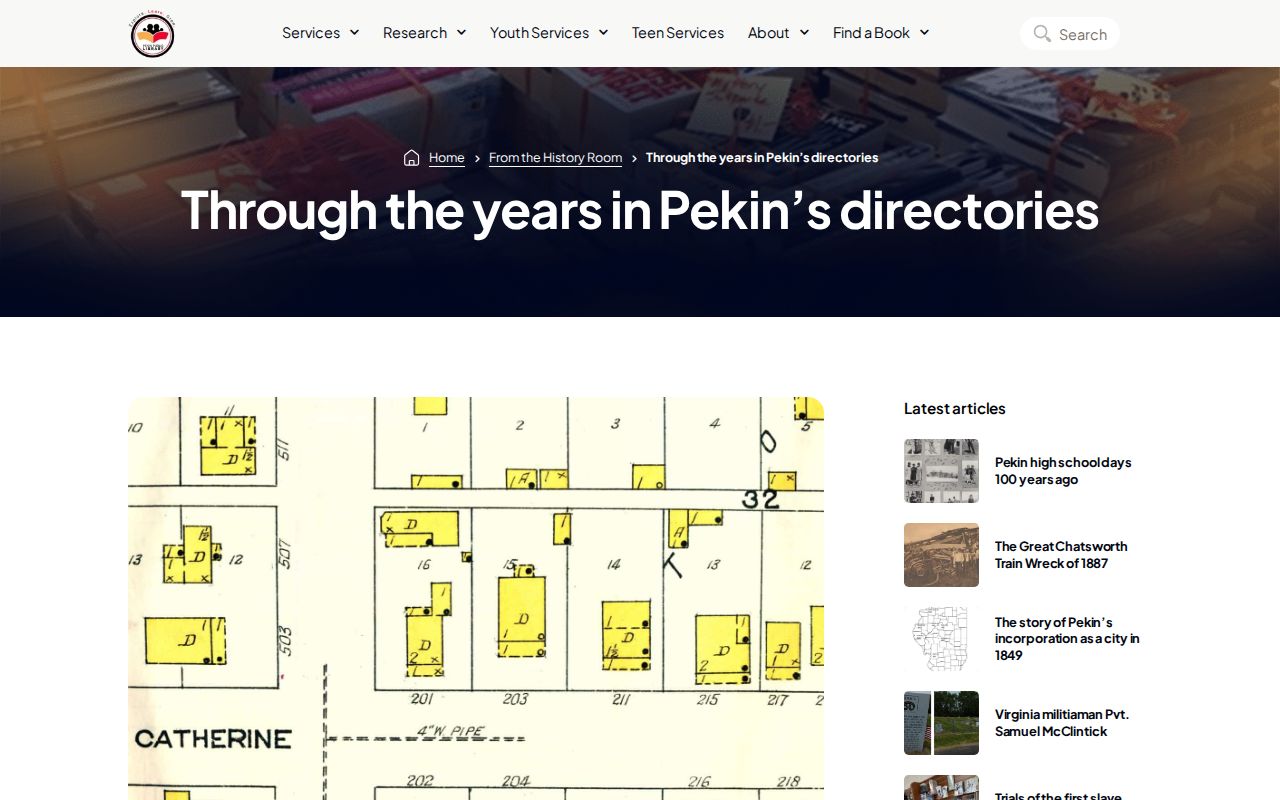
Sanborn fire-insurance maps add the building layer that a city directory lacks. University of Illinois holdings document Pekin map sets for 1885, 1892, 1898, 1903, 1909, 1916, and 1925. Sheet counts grow from 10 to 27 across those editions. The maps can show a building footprint, construction type, doors, windows, property bounds, house or block numbers, commercial use, and fire-water features. They do not identify an owner or occupant.
The Pekin Public Library describes bound local sets for 1903, 1909, and 1925. Compare a directory address with the closest map edition, then return to a directory scan or deed source for the person. Slight number differences can occur, so street and block context often matter more than an exact modern string. This human-scale check is especially helpful for reconnecting family stories to a physical block without merging occupant, owner, and structure into one claim.
Trace Pekin Families by Directory
A Pekin city directory works best as a sequence, not as one isolated page. Start with the closest known year, copy the entry exactly, and move one available edition at a time. Keep publication gaps visible. Census schedules, newspaper notices, cemetery files, and deed indexes can then test the dates between volumes.
- Find the earliest clear name hit. Record the edition, publisher, page, spelling, work note, and address.
- Move forward through each available year. Note changes in street, house number, spouse, and household shorthand.
- Use the street index in 1903-04 or a later criss-cross section to inspect the block and test an address.
- Pair the nearest directory years with federal census years. Treat each source as a dated snapshot.
- Close the trail with an obituary page-column citation, cemetery source, vital index, or deed lead.
If a current record is needed after the historical trail, shift to a modern official source. The Pekin resident lookup workflow explains how to separate a historical directory name from a voter, parcel, court, vital, or license record. Keep each date and role intact. That habit prevents a compelling family link from becoming an unsupported identity claim.